
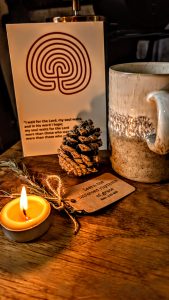
 Clare Coleman’s meditations for ‘Come As You Are’, a retreat for disabled Christians in Advent 2025. Everyone at the retreat received a box ahead of the retreat that included a pinecone and a sprig of rosemary.
____________________________________
The pinecone and the Fibonacci spiral: waiting in Advent
If you look closely or feel a pinecone starting from its base, you’ll notice spirals winding in two directions.
Count the spirals and you will find a Fibonacci number, 5 and 8 or 8 and 13, numbers from a series where each number is the sum of the two preceding it:
0, 1, 1, 2, 3, 5, 8,13, 21, 34, 55, 89, 144 and so on.
Named after a 13th century Italian mathematician, this sequence was observed in the natural world in ancient Mesopotamia around 800 BC. Pinecones share the mathematical arrangement of their scales with the Fibonacci spirals we find throughout the natural world, such as in a snail shell, a sunflower seedhead, and a galaxy!
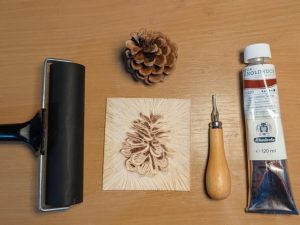
Creation is full of mathematical patterns and order emerging out of chaotic systems. The pinecone scales each house a seed, and grow at a steady pace, at just the right angle to maximise the number of seeds per cone while giving each seed just enough space to flourish. The spiralled Fibonacci series is a wisdom pattern, the optimal arrangement of petals, leaves and seeds to maximise how many seeds can be made.
Advent, too, is a spiral. Each year we circle back through waiting and hope. Not racing to Christmas but entering into God’s slower rhythm.
For many of us, time itself is experienced differently: slower, more interrupted, non-linear. The pinecone honours this experience. What may feel like delay is actually the richest way for life to unfold.
Creation teaches us how to wait fruitfully: in our waiting, to actively seek beauty, relationship and purpose.
Holding a pinecone, we remember:
- Waiting is not wasted.
- Growth happens scale by scale, spiral by spiral.
- God’s presence is already here, even as we wait for more.
The spiral in a pinecone is a parable of Advent: patient unfolding, hidden order, and hope growing at its own pace.
____________________________________
Stop and smell the rosemary
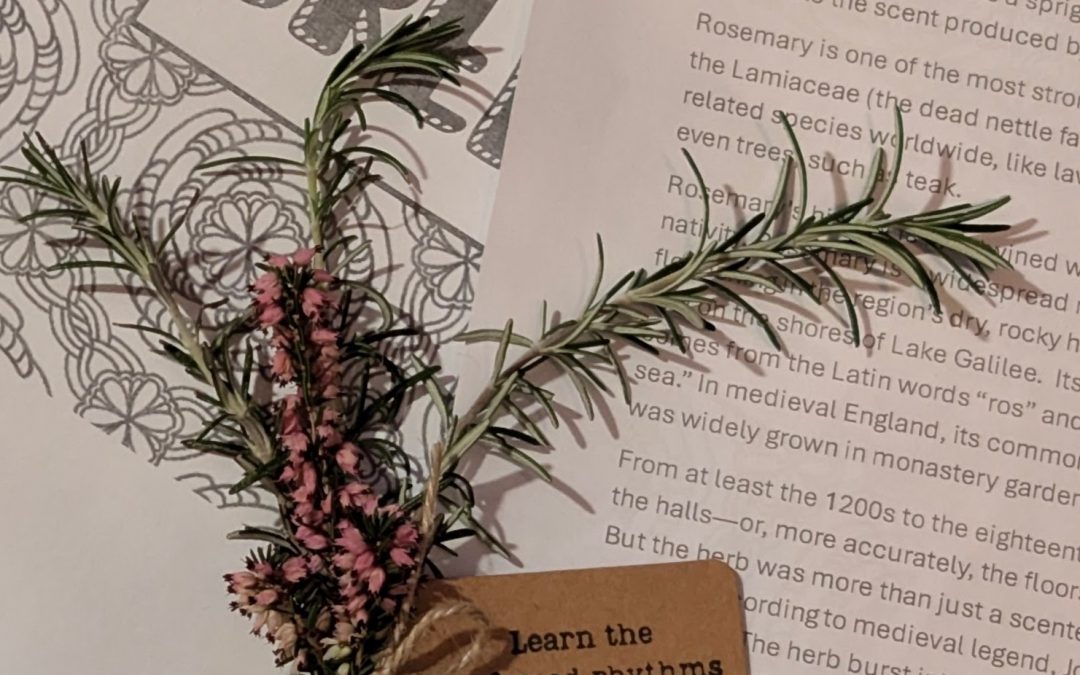
Your retreat box includes a sprig of a herb, rosemary. Rub the leaves and inhale the scent produced by the essential oils in the plant.
Rosemary is one of the most strongly scented plants in the world. It is in the Lamiaceae (the dead nettle family) along with about 7000 closely-related species worldwide, like lavender, mint, sage and thyme, and even trees, such as teak.
Rosemary’s history is intertwined with Christian traditions around the nativity. Rosemary is a widespread native plant in the Middle East, flourishing in the region’s dry, rocky habitats, especially along the coast and on the shores of Lake Galilee. Its scientific name Rosmarius comes from the Latin words “ros” and “marinus” meaning “dew of the sea.” In medieval England, its common name was rosemarine and it was widely grown in monastery gardens.
From at least the 1200s to the eighteenth century, rosemary decked the halls—or, more accurately, the floors—of churches at Christmas. But the herb was more than just a scented plant to fragrance warm spaces. According to medieval legend, Joseph picked rosemary to line the manger. The herb burst into bloom at Jesus’ birth. The story developed to a popular tradition that smelling rosemary on Christmas Eve would bring health and happiness throughout the New Year. By the Tudor period in the 1500s, rosmarine was shortened to rosmari. According to E. T. Cook’s Gardens of England published in 1908, it then became known as the rose of Mary, perhaps due to its lilac-blue flowers, this colour being associated with Jesus’ mother in medieval art.
During Victorian Britain rosemary fell out of favour for festive church decoration but was still the most widespread herb used in funerals, because it symbolised remembrance. It turns out that there might be something behind this herb’s long association with memories.
In 2015 psychology researchers at Northumbria University found that smelling rosemary enhances memory. 150 healthy people aged 65 and over were placed in rooms which had been scented with rosemary essential oils, or a control room which had no scent. Those who had been in the rosemary scented room displayed significantly enhanced memory, with test scores 20% higher than those who had been in the room with no aroma. Scientists are now investigating using rosemary in drugs to treat dementia.
Pop these stems in a glass of water and they will last for a couple of weeks. Next time you stop and smell this sprig of rosemary, remember Jesus’ words when preaching around Galilee:
“Come to me all who are weary … I’ll show you how to take a real rest. Walk with me and work with me—watch how I do it. Learn the unforced rhythms of grace.”
(Matthew 11:28-29 The Message translation)