
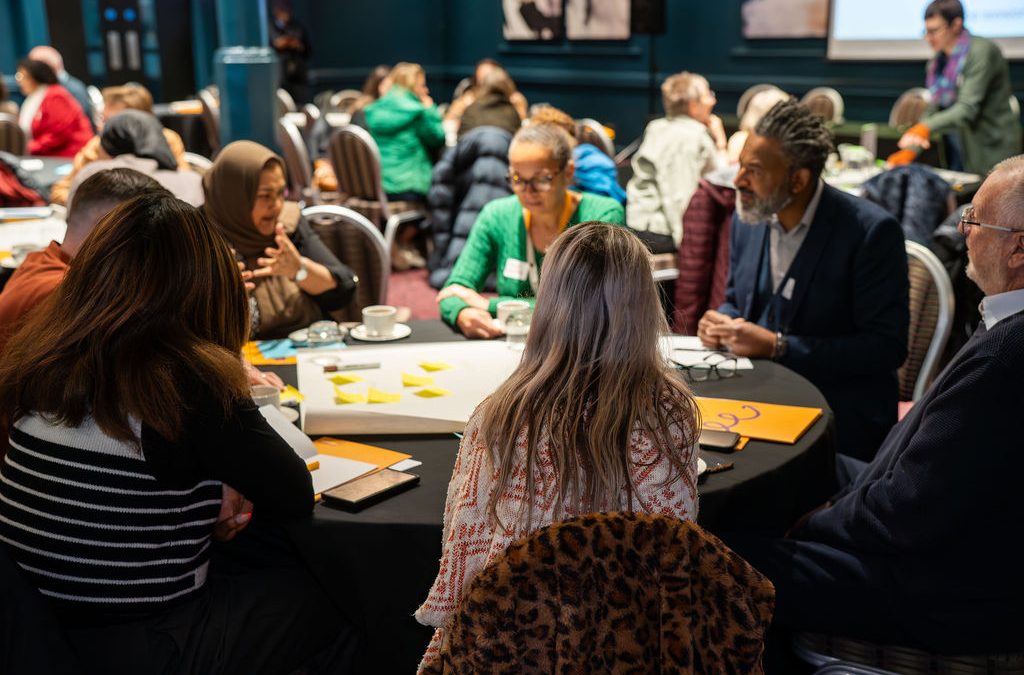
Insights from the United Against Poverty In Leeds November 2025
Paul Coleman, Faith at the Margins Lead for LCI, reflects on the theology of tackling poverty in Leeds – and shares the key lessons from our United Against Poverty in Leeds event, in partnership with Hamara, Think for Wellbeing, and Leeds North and West Foodbank.
____________________________
The Church, Stories, and the Work of Tackling Poverty
The Christian story begins with a God who hears the cry of the oppressed (Exodus 3:7) and calls a people to embody justice, compassion, and community. Throughout Scripture, the measure of a society is revealed in how it treats those who are vulnerable. The prophets remind us that true worship is inseparable from justice: “seek justice, rescue the oppressed, defend the orphan, plead for the widow” (Isaiah 1:17). Poverty is never treated as an individual failing, but as a distortion of relationships – social, economic, and spiritual – that God desires to set right.
Jesus continues this calling when He announces His ministry in Nazareth: “The Spirit of the Lord is upon me… he has anointed me to bring good news to the poor” (Luke 4:18). His kingdom is revealed as a community where dignity is restored, tables are widened, and those on the margins are brought into the centre. The early church took this seriously, sharing resources “as any had need” (Acts 2:45) and ensuring that no one was left invisible.

At the heart of this theological vision is the power of story. Scripture itself is a tapestry of stories, testimonies of struggle, resilience, and hope. Stories do what abstract concepts cannot: they reveal the image of God in one another. When we listen to the experiences of those who live with or alongside poverty, we take up the same posture Jesus did when He asked, “What do you want me to do for you?” (Mark 10:51), a question rooted in dignity, presence, and attention.
“Storylistening” then is part of discipleship. James tells the church to be “quick to listen” (James 1:19), and Paul reminds us that each member of the body has something indispensable to offer (1 Corinthians 12:22–26). Listening to stories, especially those that have been silenced or ignored, is a way of acknowledging that God is already at work in every community and that the church is called to join, not to dominate, that work.
This event and the article below both grow out of the conviction that real change begins when communities create space for honest testimony, when lived experience is taken seriously, and when churches and other local partners commit themselves to the hard, hopeful work of solidarity. Our faith teaches that poverty is not inevitable; it is something we are called to confront together, bearing one another’s burdens (Galatians 6:2) and imagining a future shaped by justice, belonging, and mutual care.
The 2022 Hook Lecture by Professor Christopher Baker encouraged churches to work in partnership with local authorities and other groups within the city. The United Against Poverty event demonstrated the need for the church to partner with others in tackling issues of social justice as well as the importance of not just telling, but also listening to the stories of those with lived experience of poverty.
____________________________
How community voices and collaboration are shaping a future beyond poverty
Paul, Jo Metcalfe (Think for Wellbeing), Raheem Mohammad (Hamara), and Georgia Whatnall (Leeds North and West Foodbank) share their reflections from the United Against Poverty in Leeds event
Stories are the seeds of change.
This was the spirit behind the United Against Poverty Event in Leeds, a gathering that united activists, community leaders, and local voices to explore how storytelling can drive social change and build resilience against poverty.
The event wasn’t just about discussion – it was about listening and imagining a future where communities thrive through collaboration and shared strength. Poverty affects us all. This event was about understanding and raising awareness of that reality.
It was a chance to ask: what can we do differently.
Event Highlights: Challenging Assumptions and Harnessing Stories for Change
The day was a powerful reminder that poverty is close to home.
 Two dynamic panels set the tone for the day. One chaired by John Battle, former MP, who didn’t shy away from challenging the status quo and asking uncomfortable questions:
What do we really mean by poverty?
Who does it affect?
And why does the narrative still feel stuck?
Adding to this, Raheem Mohammad, CEO of Hamara, chaired the second panel and spoke passionately about how poverty shows up differently across diverse communities in the city – often hidden, often stigmatised, and always complex. His challenge was clear: if we don’t understand these nuances, we risk creating solutions that miss the mark.
The first panel dismantled the idea that poverty is simply about lacking money. It’s systemic – woven into housing policy, employment access, mental health provision, and the way decisions are made. One panellist said that:
“I think poverty is often very hidden… it’s not just about a lack of money it can be a lack of opportunity that comes alongside that.”
Karen, Leeds North and West Foodbank
We explored the gaps; fragmented funding, stigma, and governance that feels too top-down. But there was hope too – enablers like local partnerships, belief in people, and the willingness to collaborate.
The challenge? Moving beyond talking about poverty as a statistic and instead recognising communities as part of the solution. Schools, sports clubs, faith, volunteers aren’t side notes, they’re lifelines.
 “It’s not the individual to sort themselves out, it’s what can we do together to tackle that” said John Battle, reminding us that poverty isn’t someone else’s problem. It’s everyone’s responsibility.
Then came the second panel – a conversation that flipped the lens from policy to power. Specifically the power of storytelling.
“Never underestimate the power of storytelling,” said Peg Alexander, because stories do what numbers can’t: they connect, they educate, entertain, inspire, and create belonging. They can make the invisible visible.
“we’re always trying to educate, entertain and inspire from stories that we tell…”
Jamie Jones-Buchannan
One metaphor stuck:
“One person starts singing a song, then all of a sudden 6,000 people are singing the same song, and then the next verse, there could be 12,000 people, and it keeps perpetuating”
Jamie Jones-Buchannan
That’s the amplification effect of a story told well. But storytelling isn’t just about speaking – it’s about listening. Tuning in to voices that have been silenced or ignored. And then weaving those voices into a narrative that doesn’t just describe poverty but demands action.
Both panels agreed: we can’t fix poverty without first fixing how we listen to the stories about it. Storytelling matters – but listening is where transformation begins. If we only tell stories without hearing the lived realities, the narrative stays stuck in charity or blame. Nothing shifts. But when we truly listen – when we absorb the complexity and the resilience – we start to build a shared story of dignity, aspiration, and responsibility. That’s the story that creates movements policymakers – and society – can’t ignore.
On reflecting, one participant shared:
“Today was a platform for me to speak about poverty – a topic that in our cultures and communities is often hidden and rarely spoken about.”
Raheem Mohammad, Hamara
Storytelling as a Strategy
Stories aren’t just for sharing experiences – they’re powerful tools for change. When we tell and listen to stories, we uncover truths that data alone can’t reveal. They help us see the human impact behind the numbers, challenge assumptions, and inspire action.
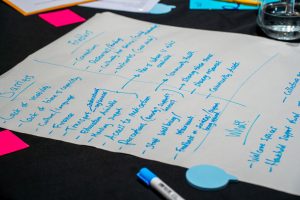
At the event, we explored how storytelling can shape a vision for the future. Think of it as creating a narrative of what a thriving, poverty-free community could look like – and then working backwards to make that vision real. This approach moves beyond external fixes and focuses on amplifying the strengths already within our communities: the networks, skills, and resilience that often go unnoticed.
But storytelling only works when it’s paired with listening. Listening deeply to voices that are often silenced or ignored ensures that solutions reflect real needs, not assumptions. As one speaker put it, “We can listen and amplify voices, but that has to be married with challenging inequality.” Stories can win hearts and minds, but listening builds trust and accountability.
Peg Alexander shared examples where stories have driven policy changes and shifted public attitudes. Facts and figures matter, but real-life experiences change perceptions – and that’s what sparks movements. When communities own their stories, they own their power.
Community Resilience & Funding Opportunities
As we move away from a crisis focused provision across the city, we must look at the strengths and assets that currently lie within our communities if we intend to truly make them resilient. This event provided a platform to showcase and identify strong examples of community resilience, ownership and pride to come together and support one another – Something the nation is keen to migrate towards as we move away from reliance of statutory and mainstream provisions.
The conversation also touched on practical steps to strengthen communities:
- The new three-year Resilience Fund aims to reduce reliance on food banks and build lasting support systems.
- Community hubs – churches, sports clubs, and networks – were identified as anchors for resilience and storytelling efforts.
Georgia Whatnall emphasised the value of cash-first models, which prioritise dignity and choice by enabling people to pay for what they need rather than relying on free handouts. This approach shifts the focus from a provider-led system to one guided by principles and purpose.
“Cash-first offers align with our community empowerment goals.”
Georgia Whatnall, Leeds North and West Foodbank
What’s next?
The event was a test, to understand gaps in the conversation, explore new ways of thinking about poverty, and gauge the appetite for using storytelling – or now, storylistening – as a vehicle for change.
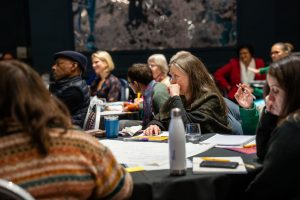 Our sense? There is appetite for a different discussion. One that moves beyond simply trying to influence decision-makers and instead takes storylistening to the next level in Leeds: giving a platform to voices that aren’t heard, voices that hold solutions if given the chance.
We also recognised something important: there’s already a lot happening across the city. The challenge isn’t to duplicate efforts but to connect the dots. That means building on storylistening through the Community Anchor Network and partners.
If you want to be part of this ongoing dialogue, please reach out to [email protected]
Poverty is not inevitable – and change starts with us.
Join the conversation. Share your story. Together, we can build a future where every voice matters and every community thrives